
CFO · Listen to the article in French
‘Dalida’: the kite has crumpled
French audio narration · original article
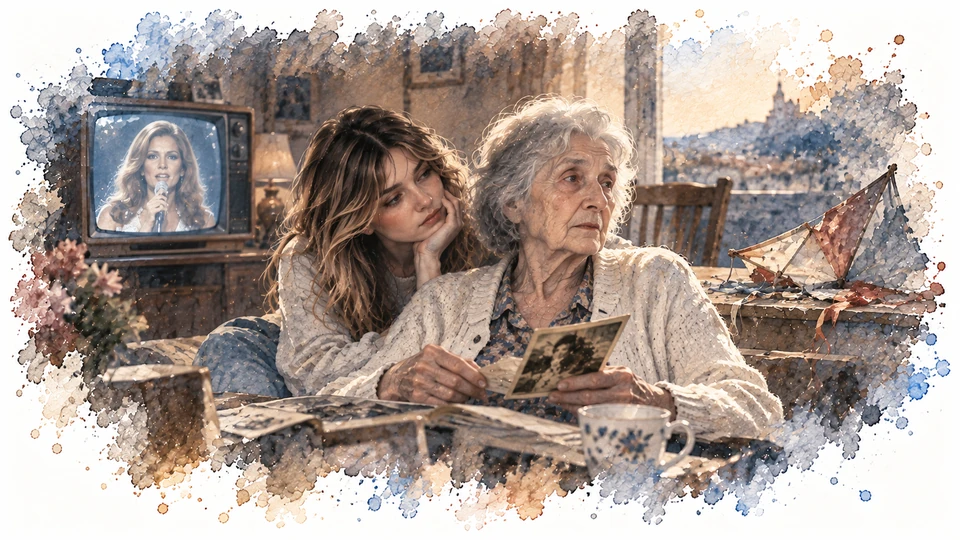
Starting from Dalida, an intimate song by Cœur maladroit inspired by her grandmother, Marine describes how Alzheimer’s disease changes shared memories. A personal story opens a wider question: what happens to our memory when someone we love begins to forget?
This feature begins with that particular story before exploring the disease and family carers’ lives. The order matters: illness never erases the person experiencing it. Understanding starts by holding together facts, what we actually know and the dignity of a family bond.
Before Alzheimer’s disease, there is a little girl and her grandmother.
A kitchen.
Marine has said she began singing at her maternal grandmother’s home. As a child, she used a baking whisk as a microphone. Long before studios, Star Academy or Zénith arenas, there was that kitchen and the grandmother she sang to.[1]
There are other memories too.
Her grandmother volunteered with Restos du Cœur in Saint-Nicolas-lez-Arras. Marine sometimes joined her: supermarket collections, distributions and children’s Christmas parties. Recalling these moments in February 2026, Marine adds something harder: she recently tried discussing them with her grandmother, but those memories have become vague for her.[2]
These things seem tiny.
That is precisely why they matter.
A shared life is not made only of major photographed events. It also consists of a song heard a hundred times, a whisk turned microphone, an afternoon distributing food parcels.
And one day, some of these certainties begin to change.
‘What has become of Dalida?’
Marine has described the moment that gave the song its title.
During a family meal, her grandmother, who has Alzheimer’s and admires Dalida, listens to the singer with them. She asks quite seriously why they no longer hear her and what has become of her.
Marine does not dare tell her that Dalida has died.[3]
The anecdote might almost raise a smile. But something else appears behind it.
It is probably not when the disease begins. Nor does it summarise Alzheimer’s.
It is simply one of those moments when illness suddenly becomes visible to a loved one in ordinary life.
Something two people thought they knew together is no longer quite shared.
Their common world begins imperceptibly to shift.
The kite
In the song, Marine finds an almost childlike image:
« Il s’est froissé ton cerf-volant. »[4]
Just a few words.
A kite does not disappear. It is still there. We recognise its shape and colours. We know what it was and what it should be able to do.
But something has crumpled.
It no longer responds to the wind in quite the same way.
This is a reading of the song, not a medical definition of the disease.
But it helps explain why Dalida reaches beyond its particular story. Marine does not describe sudden disappearance. She describes someone still present amid memories that become harder to retrieve.
Memories from before and memories from now
Initially, Marine did not want to write this song.
She explains that Dalida was added late to Cœur maladroit, that she initially did not wish to address the subject and that it is the album’s most intimate track, as well as one of its hardest to write and sing.[5]
The song brings two times face to face.
There is before : the kitchen, songs, habits and shared moments.
And there is now : those same memories, no longer available to Marine and her grandmother in the same way.
Marine retains some precisely. For her grandmother, some have become harder to retrieve.
The song becomes not a remedy for forgetting, but the trace left by the person who remembers.
Remembering for two
Perhaps that is the hardest part of being a loved one.
Family memories are normally shared. Two people can tell them together. One begins an anecdote, the other finishes it. They disagree over a detail. They remember someone, a smell, a phrase. One memory corrects or completes another.
Then that balance changes.
Some memories remain precise for one person and become uncertain for the other.
Losing a memory is therefore never just losing information. A personal memory is also a small part of the history two people could once tell together.
In Dalida, Marine expresses it in a few words:
« Je me souviendrai pour nous deux. »[4]
Alzheimer’s: when forgetting is no longer simply forgetting
Alzheimer’s disease is not simply an ageing memory.
It is a progressive neurodegenerative disease. Neuronal degeneration most often begins in the hippocampus, a region essential to memory, before gradually spreading to other brain areas.[6]
Recent-memory difficulties are among its best-known manifestations, but the disease affects more than memories. Difficulties with orientation in time and space, reasoning, planning and other cognitive functions may emerge as it progresses. Independence can gradually be affected.[6]
Above all, different forms of memory are lost neither together nor in the same way.
This can make the disease bewildering for families: someone may forget a recent event yet retain an older memory; fail to retrieve information yet remain responsive to a familiar voice or presence.
Such situations alone never measure the disease’s progression. They simply remind us that human memory is not a single block we possess completely before losing it completely.
‘She still recognises my voice’
Yet another scene remains.
Once Dalida was recorded, Marine’s mother played it to her grandmother.
Marine says her grandmother still recognises her voice. She thinks she sings well. Then, at the song’s end, Dalida returns again.[5]
For Marine, ‘it had come full circle’.[5]
The scene is moving without needing to become a demonstration: at that precise moment, something of the bond remains recognisable.
What Alzheimer’s also changes for those who remember
The disease affects a person.
But it transforms a family.
It gradually changes roles, habits, conversations and sometimes the very way people live together.
The companion also becomes the person who reminds, organises, watches and repeats. Often they preserve part of a family memory now less accessible to the other.
That is why support cannot concern only the person with the disease.
France’s Haute Autorité de Santé highlights caregiving’s consequences across many areas of life and stresses identifying carers’ difficulties and offering suitable respite solutions.[7]
A loved one is not a professional carer.
They remain a daughter, husband, brother or granddaughter.
That place must be allowed to continue existing too.
When the kite crumples
Perhaps that is ultimately why Dalida is deeply sad without being hopeless.
Marine’s grandmother is still there.
Marine continues speaking to her. She continues singing. They still share a history.
That history simply no longer belongs to them in quite the same way.
Marine remembers a kitchen.
A whisk turned microphone.
Restos du Cœur.
A family meal.
A question about Dalida.
And now, her grandmother still recognising her voice.
She cannot prevent some memories fading.
But she can continue carrying them.
Telling them.
And passing something of them on.
The kite has crumpled.
But the string is still there.
Sources and references
- [1] TF1 Info, ‘I wouldn’t really want to return to a year ago’: Marine’s portrait on Sept à Huit — memories of her grandmother’s kitchen, the whisk used as a microphone and recognition of her voice.
- [2] TF1 Info, ‘My grandmother volunteered with Restos du Cœur’ — memories of collections, distributions and Christmas parties in Saint-Nicolas-lez-Arras.
- [3] RTL2, Marine live and interviewed on Le Drive RTL2 — the family meal and her grandmother’s question about Dalida.
- [4] Paroles.net, lyrics of Dalida — source of the two very short excerpts quoted in the feature.
- [5] Charts in France, interview with Marine about Cœur maladroit, complemented by the article about Dalida — the song’s late, intimate writing and her grandmother’s response on hearing it.
- [6] Inserm, ‘Alzheimer’s disease’ — neurodegenerative mechanisms, the hippocampus’s role and changes in cognitive functions.
- [7] Haute Autorité de Santé, ‘Respite for carers’ — identifying caregiving difficulties and support towards respite solutions.
Continue reading
Other features explore complementary aspects of this question: