
CFO · Editorial transparency
Transparency, editorial standards and human responsibility.
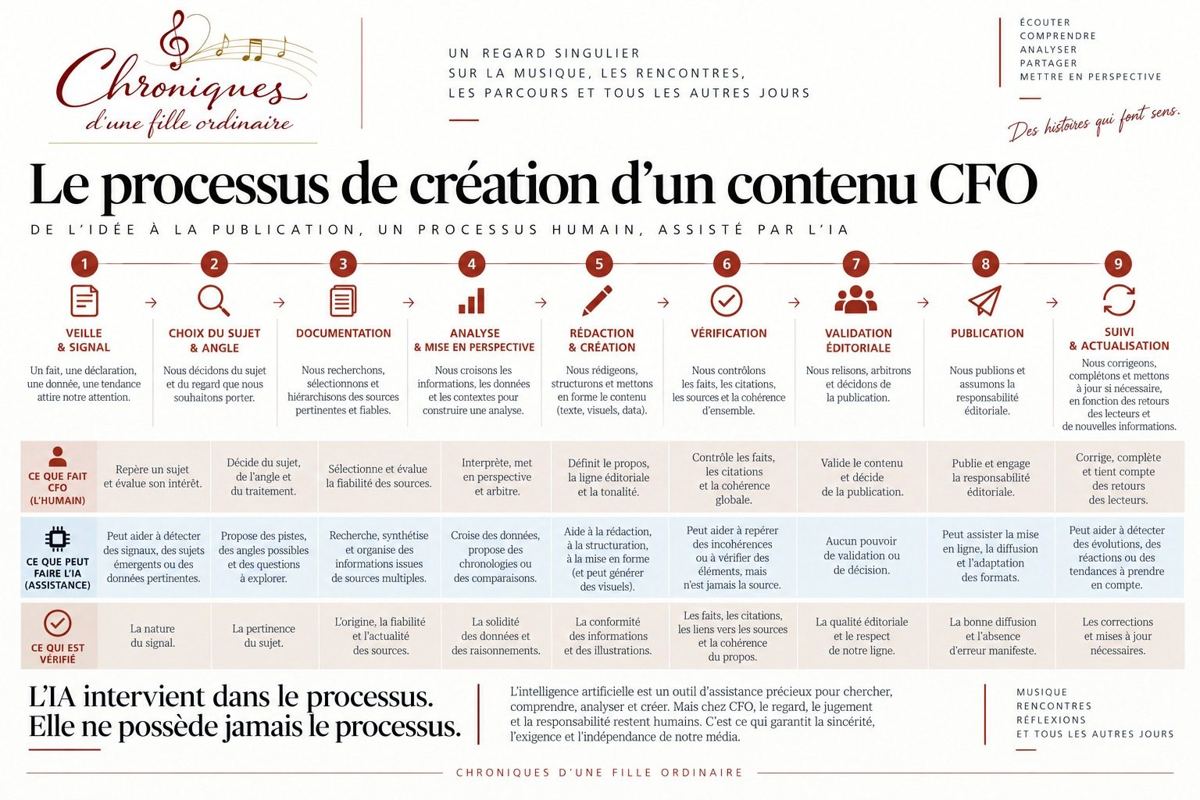
Artificial intelligence is among the tools CFO may use to research, understand, analyse, structure or create. It replaces neither sources, editorial judgement nor human responsibility.
AI-driven, human-supervised. This website is directed by Rudy Desnos, who takes responsibility for its editorial approach and published content. Read the charter shared across his websites.
Our principle
AI is a tool. It is neither a source, an independent author nor an editorial team. Rudy Desnos defines the editorial approach, validation rules and scope of automated publication. He supervises their application and takes responsibility for the content distributed.
1. Sources before AI
Factual information published by CFO must be traceable to an identifiable source. An AI-generated response is never a source in itself. When AI contributes to research or a summary, relevant information is checked against available sources before publication.
2. Distinguish facts, analysis and hypotheses
CFO distinguishes established facts, analysis, hypotheses and contextual interpretation. AI may help compare information, explore possibilities or identify connections; it does not turn a hypothesis into a fact.
3. Write with AI while retaining editorial control
AI may help structure, rephrase or summarise a text, or explore an angle. The editorial approach, perspective, decisions and published version remain under human responsibility.
4. Data, figures and analysis
AI may be used to explore, compare or explain data. CFO distinguishes observed data, calculations based on that data and interpretation. A projection, estimate or prediction is never presented as an actual measurement.
5. Images and visual creations
AI may contribute to illustrations or graphics. CFO will not use images to fabricate an event, statement or situation that could be mistaken for a real fact. Where AI creation or alteration could affect how an image is understood, its artificial nature is disclosed.
6. Quotations and people
No quotation, statement or position may be attributed to a person unless established by a source. CFO does not use AI to fabricate the words, appearance or behaviour of a real person to deceive readers.
7. Human verification and validation
Before publication, key elements — facts, quotations, figures, dates, links, sources and overall consistency — are checked. Validation and publication rules are defined by Rudy Desnos, who takes responsibility for them. Automated updates remain within an authorised, supervised scope; an anomaly or uncertainty calls for human verification before publication.
8. Proportionate transparency
CFO discloses AI use when its contribution is substantial or disclosure is needed to understand the content properly. Depending on the circumstances, this may take the form of notices such as: AI: writing assistance, AI: data analysis, Illustration created with AI or AI: substantial contribution.
9. The right to correction
Using AI never reduces our responsibility. An error must be correctable whether it originated in a source, human analysis or an artificial-intelligence tool.
AI-driven, human-supervised.
I openly use artificial intelligence to design, maintain and enrich my websites. This charter sets out the commitments that guide that use.
1. Identified human responsibility
These websites are designed and led by Rudy Desnos. I take responsibility for their direction, content and use of artificial intelligence. AI may carry out tasks; it does not assume my responsibility or determine the editorial direction on its own.
2. What AI is used for
AI may contribute to monitoring, documentary research, structuring and writing, translation, data analysis, illustrations, development and maintenance. Its role varies according to the content and the website.
3. Sources before claims
An AI response is not evidence. Facts, quotations, figures and dates must be linked to identifiable sources. Established facts, analysis, estimates and hypotheses are distinguished. Unconfirmed information is identified as such or omitted.
4. Supervised automation
Data collection, classification and updates may be automated within a defined, supervised scope. This does not mean that every update is reviewed manually. New editorial content that commits the website requires human approval; an anomaly or uncertainty calls for verification before publication.
5. Clear transparency
A substantial AI contribution is disclosed alongside the relevant content: writing assistance, AI-assisted translation, AI-assisted analysis or an AI-created illustration. This charter describes the shared framework; it does not replace the disclosures needed on individual publications.
6. Images that do not fabricate facts
Drawn portraits and illustrations created or transformed with AI are artistic representations. They are not documentary photographs. No event, interview, testimony, statement or endorsement by a real person may be invented and presented as authentic.
7. Data with understandable origins
Indicators must state their source, date and, where necessary, calculation method and limitations. An estimate is not an observed measurement; missing data does not mean zero. Fictional demonstration data must be identified.
8. Respect for people and contributions
AI use must take privacy, confidentiality and creators’ rights into account. Confidential documents and personal data must not be shared with the tools used without appropriate precautions. In forums, moderation assistance must not impersonate a real participant; disputed decisions must be open to human review.
9. Translations that preserve meaning
An AI-assisted translation is distinguished from the source text. Quotations retain their origin and their meaning must be preserved. When in doubt, readers are invited to consult the original.
10. Correctable errors and an evolving charter
AI can produce errors, misleading connections or bias. Human supervision is also fallible. A reported error must be reviewed and corrected; a significant correction must be made visible. This charter will evolve with our practices while retaining the same human responsibility.
On this website
Content about artists distinguishes official sources, personal accounts and editorial analysis. The website does not speak on behalf of artists.
To report an error, identify the page, the relevant passage and, if possible, a source that supports the correction, using the contact methods shown on the website.
Rudy Desnos
Shared charter — version of 4 October 2026.
10. A charter that will evolve
The uses and capabilities of artificial intelligence evolve rapidly. This charter may therefore be adapted to maintain the same principle: use available tools while preserving editorial standards, transparency and responsibility.
AI participates in the process. It never owns the process.
At CFO, artificial intelligence may contribute to the work. It replaces neither sources, judgement nor human responsibility.